If you are a distributor, wholesaler, procurement manager, repair shop, or OEM factory, this article is worth a read. It combines professional knowledge of automotive systems, from the overall system cycle, the function of each key component, to the signs of component failures. The goal is to help you choose the right products, make informed decisions, and provide your customers with more professional support.
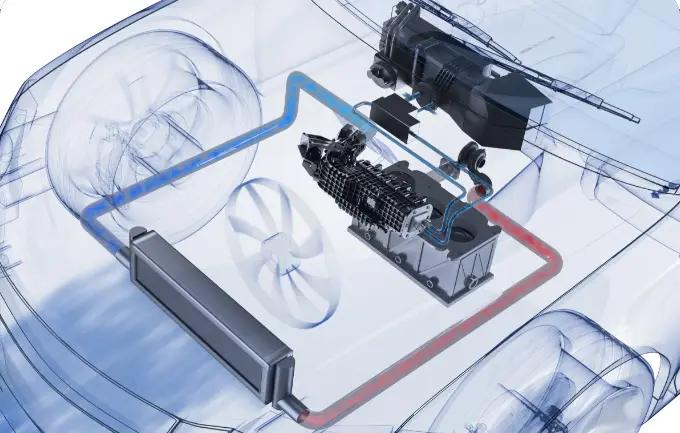
In simple terms, a car air conditioning system operates through a continuous cycle of refrigerant changing between gas, liquid, and mixed states. During this cycle, the refrigerant absorbs heat through evaporation and releases heat through condensation, which is the core principle behind automotive cooling.
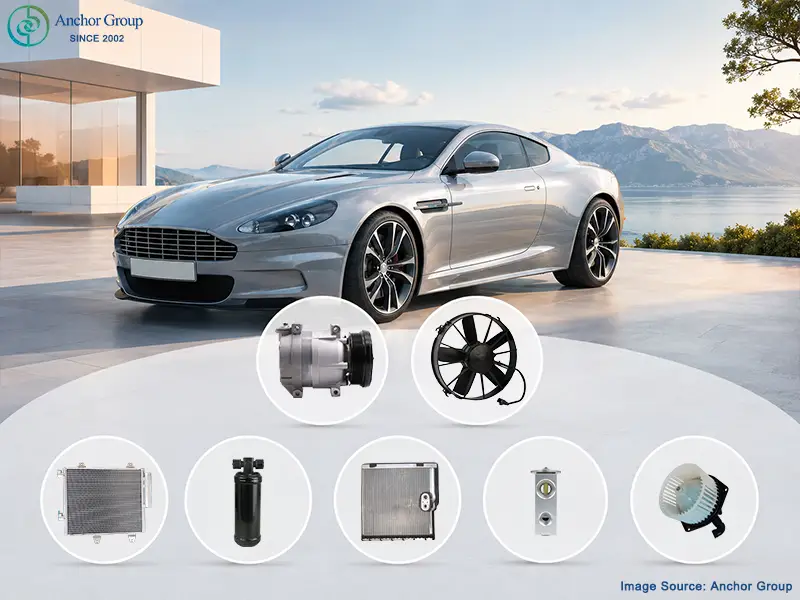
In the AC cycle, the refrigerant constantly evaporates and condenses, absorbing and releasing heat. Understanding the role of each component helps you better understand system operation and troubleshoot issues.
Compressor
The compressor is often called the “heart” of the car air conditioning system because it compresses low-pressure, low-temperature gas into high-pressure, high-temperature gas. Different types of vehicles use different compressors, so selecting the right one should be based on the specific vehicle model.
Condenser
After leaving the compressor, the refrigerant flows into the condenser. The condenser transforms the high-pressure, high-temperature gas into high-pressure liquid while releasing heat. A condenser fan blows outside air across the condenser to dissipate the heat into the atmosphere.
Receiver-Drier
The liquid refrigerant then passes through the receiver-drier, which removes moisture to prevent freezing or corrosion in the system. It also filters out debris to prevent clogging of the expansion valve.
Expansion Valve
The high-pressure liquid refrigerant passes through the small opening of the expansion valve, which causes a sudden drop in pressure. This lowers the boiling point of the refrigerant and partially vaporizes it, creating a low-pressure liquid-gas mixture.
Evaporator
In the evaporator, the refrigerant absorbs heat from the surrounding air, fully vaporizing into low-pressure, low-temperature gas. The blower draws in warm cabin air, passes it through the evaporator to cool and dehumidify it, and then delivers cold air to the interior.
Cycle Restart
After leaving the evaporator, the low-pressure gas returns to the compressor, starting a new cycle.
Understanding the role of each key component makes it easier to identify problems in the AC system. Each component shows specific signs when it malfunctions.
Compressor Failure Signs and Causes
Condenser Failure Signs
Receiver-Drier Failure Signs
Also Read 7 Common AC Dryer Failures and Expert Solutions for Replacement and Maintenance
Expansion/Control Valve Failure Signs
Also Read:Understanding the AC Compressor Control Valve Function in Automotive Air Conditioning Systems
Evaporator Failure Signs
A car air conditioning system may seem complex, but understanding its cycle and the role of each component makes troubleshooting and maintenance much easier. By recognizing the signs of component failures, distributors, wholesalers, repair shops, and OEMs can select the right products, make informed purchasing decisions, and provide better technical support to customers.
Mastering this knowledge not only improves service quality but also enhances trust and credibility with clients, ultimately supporting business growth in the automotive HVAC market.