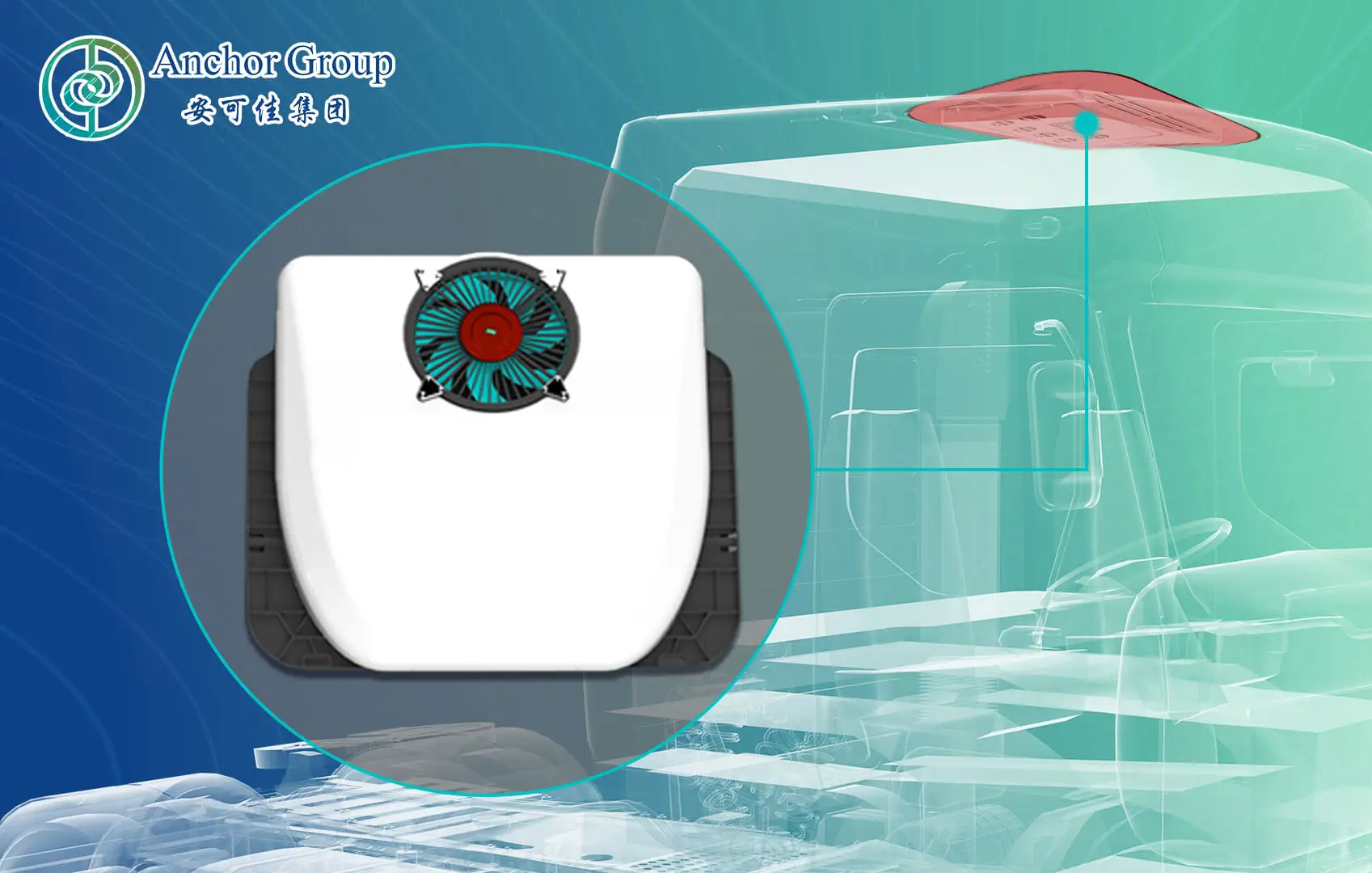
1. Truck Air Conditioners and How They Work
A truck AC also called truck parking air conditioning system is a climate control unit installed in commercial vehicles to regulate cabin temperature — particularly during rest periods when the engine is off. For long-haul drivers who spend extended hours in the sleeper cab, reliable cooling is not a comfort option but a safety necessity.
Truck AC units fall into two main categories: all-in-one (integrated) units and split systems.
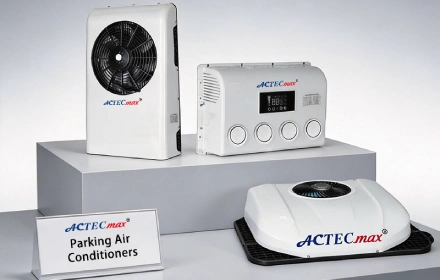
All-in-One Units integrate all core components — compressor, condenser, and evaporator — into a single housing, typically mounted on the truck’s rooftop. This design simplifies installation and keeps the footprint compact, making it the preferred choice for most parking AC applications.
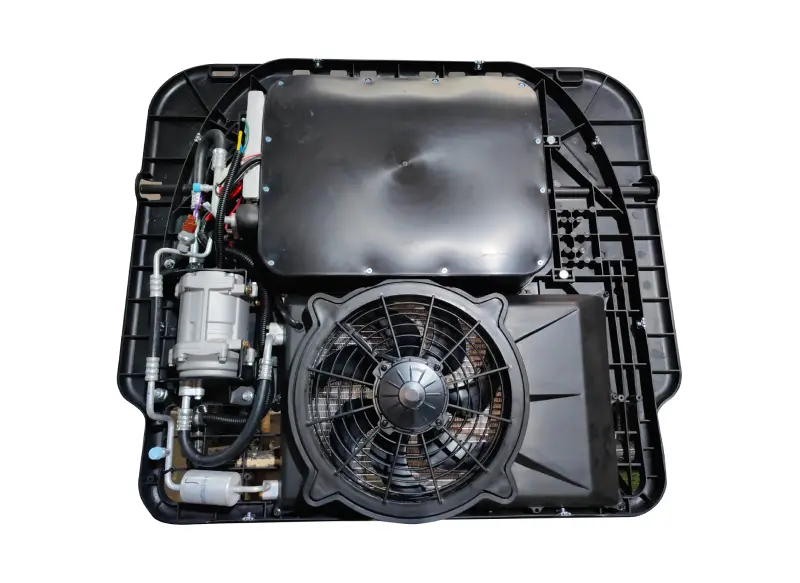
The structure of all-in-one (integrated) units
Split Systems separate the indoor and outdoor units. The indoor unit (evaporator assembly) is mounted on the cabin’s interior side wall, while the outdoor unit (condenser and compressor assembly) is installed under the chassis or at the rear. A split system includes the following components: indoor evaporator unit, outdoor condenser/compressor unit, refrigerant lines, mounting brackets, power cables, evaporator wiring harness, remote controller, drain hose, sealing tape, and hardware pack.
Split systems offer greater installation flexibility and a lower roofline profile, making them well-suited for applications where roof clearance is a concern.
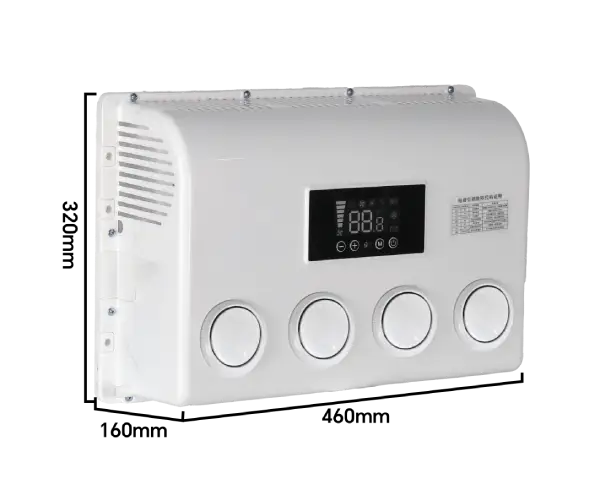
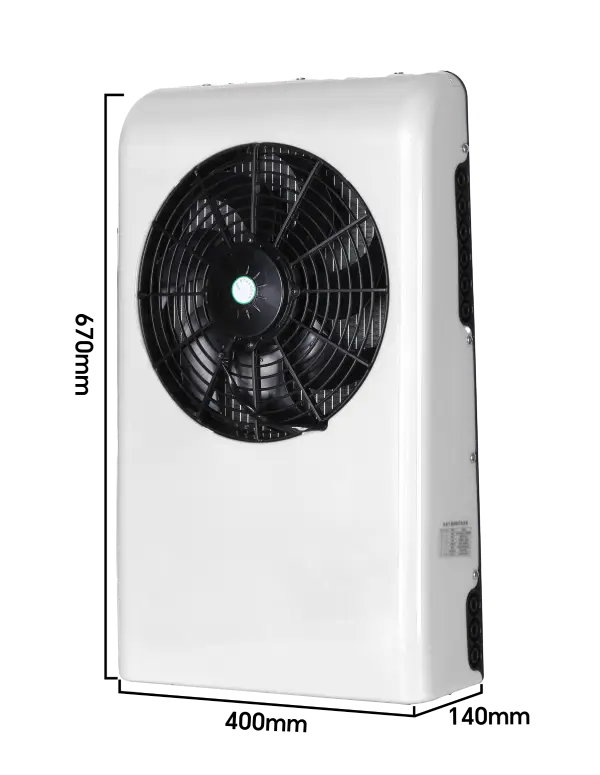
Inner Unit Outer Unit
2. Features of Truck Air Conditioning Units
Commercial-grade truck AC units are engineered to perform reliably under demanding conditions. Key features include:
- High Cooling Capacity — Designed to rapidly cool large cab volumes, even in extreme ambient temperatures above 40°C (104°F).
- Low Power Consumption — Advanced compressor and motor designs minimize battery draw, allowing extended operation without draining the vehicle’s electrical system.
- Quiet Operation — Brushless motor technology and optimized airflow design reduce noise levels, supporting restful sleep for drivers on rest breaks.
- Durable Construction — UV-resistant housing, corrosion-proof components, and vibration-dampened mounts ensure long service life in harsh road environments.
- Flexible Power Compatibility — Most units support both 12V and 24V DC power supplies, as well as 110V/220V AC shore power, providing maximum operational flexibility across different regions and setups.
- Easy Maintenance — Washable filters and accessible service panels reduce maintenance downtime for fleet operators.
- Smart Controls — Digital thermostats with programmable timers, sleep modes, and remote or app-based control options are increasingly standard on modern units.
3. Applications of Truck AC
Truck parking AC units serve a wide range of commercial and industrial applications:
- Long-haul semi-trucks and sleeper cabs — The primary market, providing overnight cooling during mandatory driver rest periods
- Refrigerated transport vehicles — Cab comfort units separate from the cargo refrigeration system
- Construction and mining vehicles — Heavy equipment operator cabs in off-road environments
- RVs and camper vans — Leisure and mobile living applications requiring compact, self-contained cooling
- Emergency and utility vehicles — Ambulances, command vehicles, and mobile workshops requiring stable cab temperatures
For OEM customers, these units can be factory-fitted as standard or optional equipment. For distributors and fleet operators, aftermarket installations offer a cost-effective upgrade path for existing vehicle fleets.
4. How to Choose the Right Truck Roof Air Conditioner
Selecting the right unit requires evaluating several key parameters:
- Cooling Capacity (BTU/h or W) — Match the unit’s output to the cab volume. A standard sleeper cab typically requires 8,000–12,000 BTU/h. Larger cabs or hotter climates may require higher-capacity units.
- Power Source — Confirm whether the installation site has access to shore power (AC) or relies solely on battery/alternator power (DC). Units with dual AC/DC capability offer the greatest flexibility.
- Power Consumption — For battery-powered operation, calculate runtime against available battery capacity. Lower watt-hour draw directly extends operational hours without engine idling.
- Unit Type — Choose an all-in-one rooftop unit for simplicity and ease of installation, or a split system if roofline clearance is limited or a cleaner interior aesthetic is preferred.
- Noise Level (dB) — Critical for sleeper cab applications. Look for units rated below 45 dB for comfortable overnight use.
- Operating Temperature Range — Ensure the unit is rated for the ambient temperatures of the target deployment region.
- Certifications — For export and OEM applications, verify relevant compliance certifications (CE, RoHS, FCC, E-Mark, etc.) based on the destination market.
5. Where Should a Truck Air Conditioner Be Installed?
Installation location depends on the unit type:
All-in-one rooftop units are mounted directly on top of the cab. This is the most common configuration, offering a clean installation with minimal cabin intrusion. The rooftop position also maximizes airflow efficiency for both the condenser and evaporator sides.
Split systems offer more installation flexibility. The outdoor compressor and condenser assembly is typically mounted under the chassis frame or at the rear of the cab, keeping it protected from road debris. The indoor evaporator unit is fixed to the interior side wall of the sleeper cab, where it delivers cooled air directly into the living space without occupying roof space.
Proper sealing, vibration isolation, and cable management are critical for both installation types to ensure long-term reliability and water ingress prevention.
6. Why Does a Truck AC Need an Auxiliary Power Unit (APU)?
A key challenge for truck parking AC is power supply. When a truck is parked with the engine off, the main alternator is not generating power. Running the engine at idle to power the AC is inefficient, costly, and increasingly restricted by anti-idling regulations in many regions.
An Auxiliary Power Unit (APU) solves this by providing an independent power source — either a small diesel generator, a battery bank, or a fuel cell — that supplies electricity to the AC unit and other cab electronics without running the main engine.
The benefits for fleet operators are significant:
- Fuel savings — APUs consume significantly less fuel than idling the main engine
- Reduced engine wear — Eliminating overnight idling extends main engine service intervals
- Regulatory compliance — Meets anti-idling laws in the US, EU, and other regulated markets
- Lower emissions — Reduced total fuel consumption cuts CO₂ and particulate output
For distributors and fleet procurement teams, offering truck AC units alongside compatible APU solutions — or ensuring AC unit compatibility with common APU platforms — is a strong value-add that supports higher-volume sales.
7. Why Does a Truck Sleeper AC Have a Peculiar Smell?
A common complaint among truck drivers is an unpleasant odor from the cabin AC unit, particularly when first switched on. Understanding the causes helps distributors and end users address the issue effectively.
Common causes include:
- Mold and mildew growth — The evaporator coil and drain pan operate in a humid environment. If the unit is not run in “fan only” mode for a few minutes after cooling to dry out residual moisture, mold and bacteria can develop on the coil surface, producing a musty smell.
- Dirty air filter — Accumulated dust, debris, and biological matter on the filter degrades air quality and produces odors when airflow passes through.
- Refrigerant leaks — A sweet or chemical odor can indicate a minor refrigerant leak at fittings or the evaporator coil. This requires immediate inspection and repair.
- Cabin environment — Food residues, sleeping materials, and general cab use in an enclosed space can introduce odor sources that the AC system then circulates.
- New unit off-gassing — Brand-new units may emit a mild plastic or adhesive smell during initial use, which dissipates after the first few operating hours.
Recommended maintenance practices:
- Clean or replace the air filter every 30–60 days under regular use
- Run the fan without cooling for 5–10 minutes after each cooling session to dry the evaporator
- Inspect and clean the evaporator coil and drain pan at least once per season
- Check refrigerant lines and fittings annually for signs of leakage
For distributors supplying fleet operators, providing clear maintenance guidelines alongside the product significantly reduces after-sales complaints and supports long-term customer relationships.
Anchor Group supplies truck parking AC units for OEM integration, wholesale distribution, and fleet procurement. Contact our team for volume pricing, customization options, and technical support.